.jpeg)




Your experience means nothing to me
Experience used to compound. In ecommerce, it depreciates.
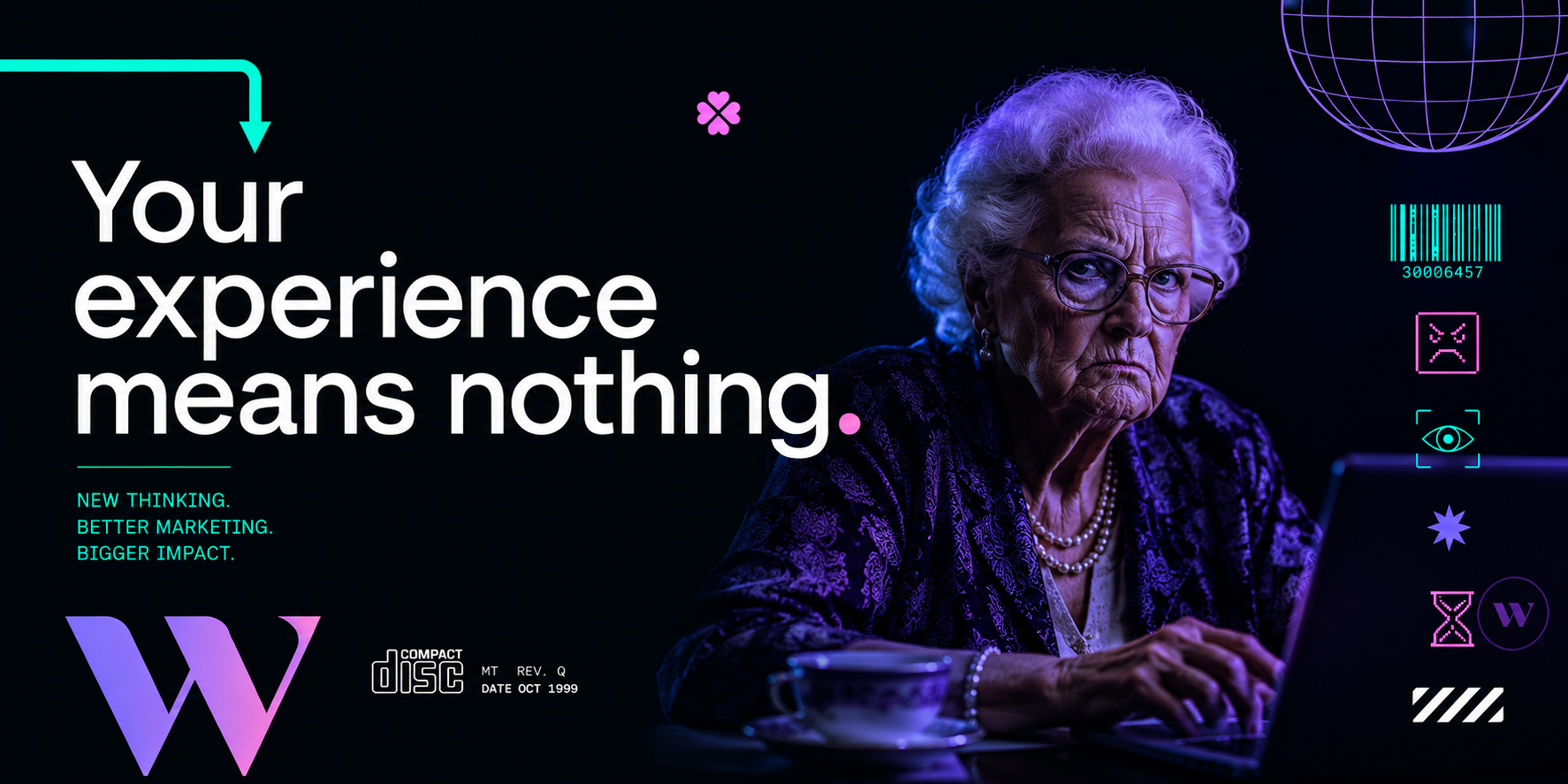
Every agency website has the same line somewhere near the top. "Over a decade of experience." Sometimes it's "15+ years". Occasionally, if the founder is old enough to remember Magento Go, it's "two decades".
It's meant to reassure. What it actually says is: we were good at something once.
I run a marketing consultancy for ecommerce agencies and SaaS companies, so I spend a lot of time looking at how agencies sell themselves. And the longer I do it, the more convinced I am that "years of experience" is the least useful thing an agency can put in front of a buyer. Not because experience is worthless. Because in this industry, most of it has expired.

The half-life of knowing things
Think about what an ecommerce agency actually knew in 2014. How to theme a Magento store. How to get organic reach on a Facebook page. How to write meta descriptions that Google would respect. How to set up a welcome series in Mailchimp and call it CRM.
Almost none of that is relevant now. The platforms have changed, the channels have changed, the buyer has changed, and the tooling underneath all of it has been ripped out and replaced at least twice.
Now think about what an agency knew in 2023. Klaviyo flows. Shopify Plus checkout customisation. Meta's Advantage+ campaigns. Reasonably current. Already going soft at the edges.
Now think about the last twelve months. AI agents writing and testing copy. Search traffic leaking to ChatGPT and Perplexity. Shopify shipping features faster than most agencies can read the changelog. Lovable and Supabase letting a marketing exec build a working tool in an afternoon that would have been a six-week dev quote two years ago.
The half-life of useful knowledge in this industry used to be about five years. It's now closer to eighteen months, and I'd argue that's generous.
So when an agency tells me it has twelve years of experience, my honest response is: which twelve months?
Experience used to compound. Now it depreciates.
In most professions, experience is an asset. A surgeon with twenty years behind them is better than one with two. The body hasn't changed much.
Ecommerce isn't like that. The body changes every year. Sometimes every quarter.
Which means experience in this industry behaves less like a pension and more like a van. It loses value the moment you drive it off the forecourt, and if you don't keep it serviced it stops working entirely. Worse, it makes you confident. And confidence built on things that used to be true is the most dangerous quality an agency can have.
I've sat in pitches where a founder explained, with total sincerity, a channel strategy that would have been sharp in 2019. Nobody in the room wanted to say so. The client bought it anyway, because "fifteen years" sounds like safety.
It isn't. It's just a number that hasn't been questioned.

What buyers should actually ask for
If I were a brand hiring an agency tomorrow, I would ignore the years entirely and ask one question: show me what you've done since last September.
Not the greatest hits. Not the award from 2021. Not the logo wall, which is just a list of companies who once paid you. The last twelve months. What did you build, what did you change, what did you learn that you didn't know a year ago?
That answer tells you three things a "years of experience" line never will.
First, whether the agency is actually doing the work now or coasting on reputation while the juniors figure it out.
Second, whether they've adopted the tools that are reshaping the job, or are still explaining to clients why AI is "not quite there yet" because they haven't got round to trying it properly.
Third, and this is the one that matters, whether they can learn. Because the only durable skill left in this industry is the ability to unlearn what worked last year and pick up what works now, quickly, without sulking about it.
The case study problem
Here's where agencies make it hard for themselves. Most agency case studies are old. Not ancient, but old enough that the work described was done on a version of the platform that no longer exists, with a channel mix that no longer applies.
They're also frozen. Written once, published once, never revisited. A case study from 2022 describing a Klaviyo migration is, in 2026, roughly as useful as a review of a restaurant that changed chef three times.
The fix isn't complicated. Your case study library should be a rolling twelve months. Anything older gets archived, not deleted, but taken off the shop floor. The front of house is the last year only.
That sounds brutal. It's meant to. If you can't fill a page with work from the last twelve months, that's not a marketing problem. That's the problem.

What we tell clients about us
So here's how we talk about Waye, and how I think every agency should talk about itself.
Don't hire us because we've got years of experience. We have, and most of it is in a drawer somewhere with the Magento certificates.
Hire us because of the last twelve months. Because we spent them rebuilding how we work around AI, week by week, in client campaigns that shipped. Because our team builds tools now instead of briefing developers to build them. Because the case studies on our site are from this year, and next year they'll be different ones.
The agency bragging about two decades is bragging about knowing how to fax. The agency worth hiring is the one that can tell you, in detail, what it got wrong in March and fixed in April.
Twelve months. Not twelve years. If your agency's best work is behind it, the buyer will find out eventually. Better they find out on your website than six months into the retainer.