




The 50% shakeout: why half of ecommerce agencies may not survive AI
What a year of agency summits shows about who's pulling ahead with AI
Half of us won't be here
At the EAG agency retreat in Gran Canaria, straight after the Seville summit, Rachel Jacobs, founder of Ecommerce Agency Growth, opened with a prediction. Around half of today's ecommerce agencies won't exist in three to five years.
Rachel has spent a decade consulting with thousands of agencies, and she's watched plenty of them die already, mostly of ordinary causes like a lost anchor client or a founder who got bored.
Her point was that AI is about to make those ordinary causes arrive much faster.
I've co-hosted these events with Rachel and Tiara Tragas all year, from an agency retreat in Colombia in January through Austin, Australia, Edinburgh and Seville. Looking back through my notes, Gran Canaria wasn't where the split started. It has been widening in front of us since the spring.

How the numbers break down
Her split was roughly 20% of agencies investing in AI with real intent, another 40% who'll eventually copy whatever the leaders do, and a remaining half drifting towards the exit. Of the survivors, she thinks only 5 to 10% will actually lead.
She called it a hypothesis, and it is one, but the gap between the top and the middle is already measurable.
One enterprise agency in the room shared its numbers. It spends $30,000 to $50,000 a month on AI, has made early-stage R&D work 20 to 50% more efficient and repeatable processes 30 to 100% more efficient, and an internal survey found 63% adoption across its 147 staff.
Most agencies I talk to have a ChatGPT Team licence and a Slack channel called #ai-ideas that nobody has posted in since March.

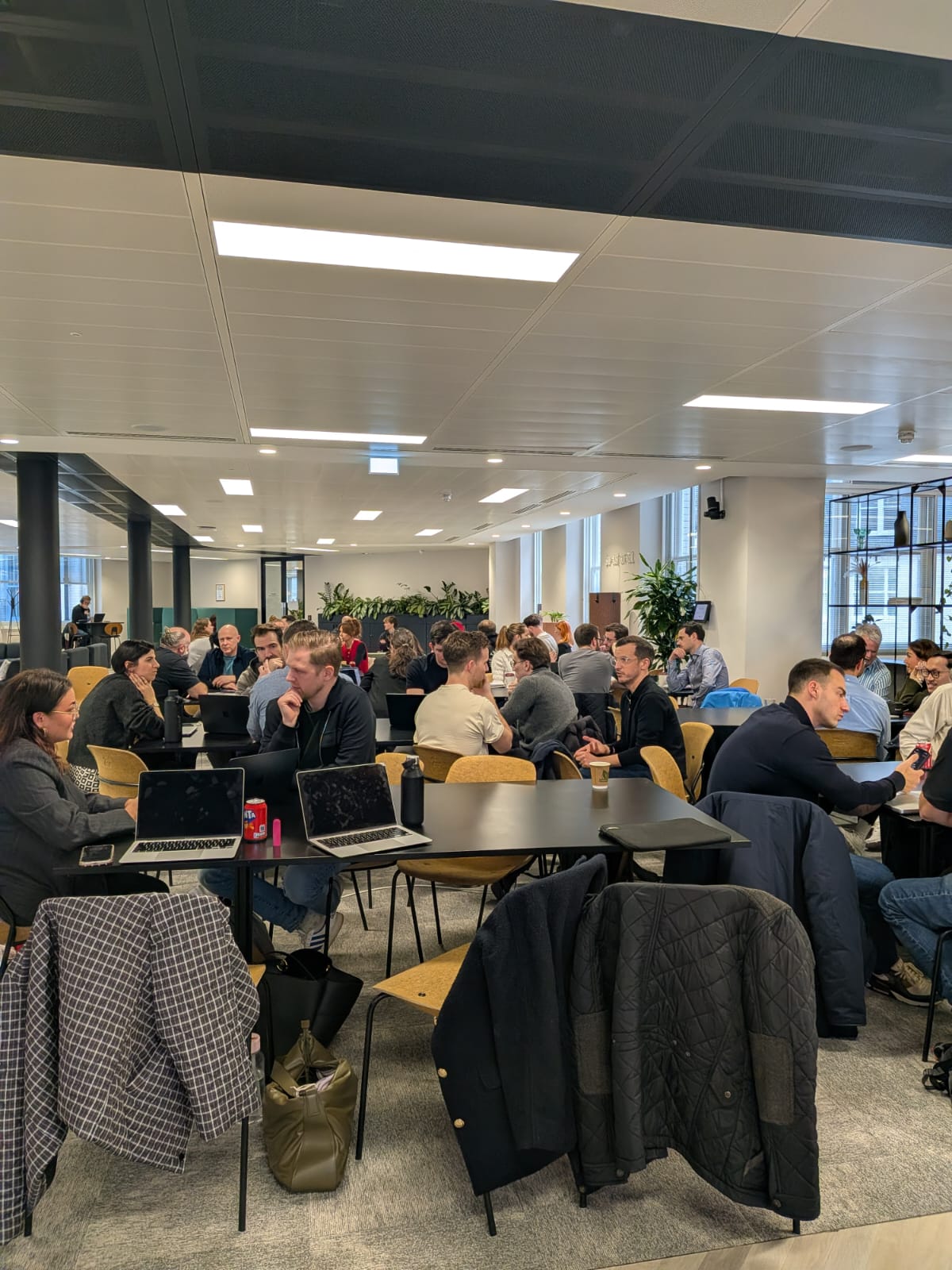
Just a handful of the agencies at the Gran Canaria Retreat
We've been watching it happen all year
My notes start in Austin in April. Since then, the same question has come up at every event: what happens to an agency's services once AI can do the work?
A month later in Australia, Klaviyo's partnerships team ran a quick show of hands. Most agencies in the room used AI to run their own operations, but far fewer had packaged it into something a client could buy. Klaviyo's view was that using AI internally is now the minimum and the growth is in selling it to clients. Agencies there were also starting to be asked how AI efficiencies would show up in their pricing.
By Edinburgh in July, only three or four agencies in a room full of agency leaders were offering AI as a service to clients. Everyone else was using it to make their existing services slightly cheaper to deliver.
That's a problem, because if AI only makes you faster at what you already sell, the client eventually pockets the difference.
Also in Edinburgh, Grant from Grantbot gave the room a test I keep coming back to: if your best AI user quits tomorrow, does their work stay? In most agencies it doesn't, because it lives in one enthusiast's folder of prompts and none of it belongs to the business.

Annual Planning with agencies in Colombia
The cost of sitting it out
On a panel in Seville, I said that doing nothing now is worse than doing nothing last year. Another founder put it better: the baseline for quality is rising ridiculously fast.
The problem is compounding. An agency that started properly twelve months ago has a year of documented processes and working prompts, and you can't buy that back in a quarter. Mac King, co-founder of Domaine, made the same point on stage in Australia, warning that agencies who start late may end up having to buy their way back in.
Pricing is usually where this shows up first. An ops lead at the workshop said tasks are now finishing in a fraction of their estimated time, which means an agency selling hours gets paid less the better its AI works. Effort-based KPIs stop meaning much when the effort disappears, so the agencies ahead of this are moving to outcome-based pricing and metrics like retention and MRR.
"Don't hide that you're using AI, and don't discount yourselves for it either. Clients aren't paying for the hours, they're paying for the expertise to get it right. So find a way to reinvest the time you save into more strategic thinking, sharper creative and faster results, and price for that value. On team KPIs, the utilisation, billable and overall targets you set should stay the same. What changes is how people hit them. With AI doing the heavy lifting, they should reach those targets by delivering more work for more clients, not by stretching the same work across more hours."

EAG Members at the EAS summit in Austin Texas
Rachel was clear about who goes first. Specialist agencies can still win as full-service shops or by being excellent at one thing, but button-pushers are in trouble.
A button-pusher runs the platform and builds the flows without owning any insight the client couldn't get somewhere else. AI happens to be extremely good at pushing buttons, and it doesn't take holidays.
The alternative she described is a data intelligence layer around your ideal client. Every audit and sales call is a data point about your niche, and if you pull them together you know things about your corner of ecommerce that nobody else does. Brands can't get that from a prompt, which is why they'll keep paying for it.
Brenden Rawson at Andzen gave the clearest version of this in Australia. Every agency has access to the same AI, from ChatGPT and Claude through to the tools built into Shopify and Klaviyo. What differs is the proprietary layer on top. His line was that AI is the engine and IP is the fuel, and he defined IP as decisions multiplied by repetition over time.

Brenden Rawson from Andzen sharing his AI processes at EAS
Andzen has turned ten years of audits and quotes into its own tools. Its audit assistant, trained on a decade of problem and solution pairs, diagnosed the cause of a returning client's KPI drop in about 15 minutes. Its quoting calculator prices work from ten years of real timesheets, so sales stops promising things delivery can't do.
I asked Rachel what she'd say to the founders who are sure they're in the safe half.
"Almost all the agencies I've spoken to who feel they're in the 'safe 50%' aren't. They just feel confident. They're not actually future-proofing their business. Agencies need to focus on four things. Automate internal systems and processes to essentially remove the bottom layer of junior and mid-weight roles. Invest in more senior strategists and experienced solutions architects. Fix your positioning in the market, because everyone is AI-first. And build a data intelligence layer into the business. If they get those things covered, I'd say yes, that's an agency on the right path."
What the top 10% are doing
None of the agencies ahead of this had a secret tool, and most of what they described sounded unglamorous.
Adrian from Tante-e walked through his agency's "Engine Room", a Notion-based brain fed automatically from Trello, Slack and call transcripts, so anyone can ask how the agency handles something and get a real answer. His main lesson was that automating a messy process just gets you a faster mess, so fix the process and give the brain an owner before you automate anything.
The founders getting results also set the rules from the top. Plenty of agencies have a few self-taught AI enthusiasts each doing their own thing, which produces islands of clever work nobody else can use. One speaker put AI adoption at 70% people and 30% technology, with the founder defining a framework for each department and internal champions working inside it.
They also check that speed isn't costing them quality. The enterprise agency tracks AI's impact across the whole project lifecycle, has built a 13-stage agent to handle low-priority bugs and now treats scoping as structured data. In Australia, Angus Cowan showed an AI command centre that watches benchmarks across every account and reads sentiment across Slack, email and calls, so leadership can spot a churn risk early.

EAS in Sydney - Australia’s agencies turned out en-masse
And they sell AI outcomes to clients. Domaine moved Marc Fisher's six brands onto a single Klaviyo setup in four weeks, under public pressure, and the results shared in Australia included 46% year-on-year growth in SMS revenue and a 20% cut in CRM execution time. Domaine now leads with an AI readiness audit. Elsewhere, agencies are packaging the tools they built for themselves to sell to other agencies and brands, and one is projecting a 31x return across 800 products for Alpinestars from answer engine optimisation work.
The view from Domaine
Mac King helped launch the Shopify Plus Partner Program before co-founding Domaine. I asked him where the agency's job goes next.
"Think about a Shopify Plus brand. They're probably running 40-odd systems, and every one of them has shipped its own AI this year. Nobody's looking at how it all fits together, and honestly, that's the agency's job now. If you're still just pushing buttons inside each tool, you're doing work the AI's about to do for free. The agencies that get on top of that now are the ones brands will trust with the whole stack."

EAG members at the Ecommerce Agency Summit Seville
The view from Andzen
Brenden's demos at the EAS events have been some of the most practical sessions of the year. I asked him what building Andzen's own tools has changed.
"Building out Andzen OS, our internal ERP, and the customer products that have come from it has been one of the most exciting and fulfilling projects we've worked on at the agency. We're at a point where AI is exploding and the cost of building has fallen so far that creating our own tools is no longer just feasible; it's necessary. The power has truly shifted from those who can code to those who can solve problems and build! Spreadsheet workarounds and double data entry across internal processes can now be replaced by a single platform where our data, systems and workflows live together. What a time to be alive."
Where to start on Monday
You don't need a $50k monthly AI budget to get on the right side of this, but you do need to start now.
Start with one process your team runs every week, write it down properly and automate it. Then work out what you know about your niche that nobody else does, and if the answer is nothing, building that knowledge is your real AI strategy. It's also worth asking whether leads would still come in if you disappeared for three months.
Rachel's 50% figure might turn out to be too high or too low, but the gap between the agencies acting on this and the ones waiting has been obvious at every event this year.

Leaving you with the highlight of the year - taming the metal beast in Texas!