




Your agency isn't sellable if you are the marketing
Buyers will pay for your clients, your team and your margins. What they won't pay full price for is new business that walks out of the door with you.

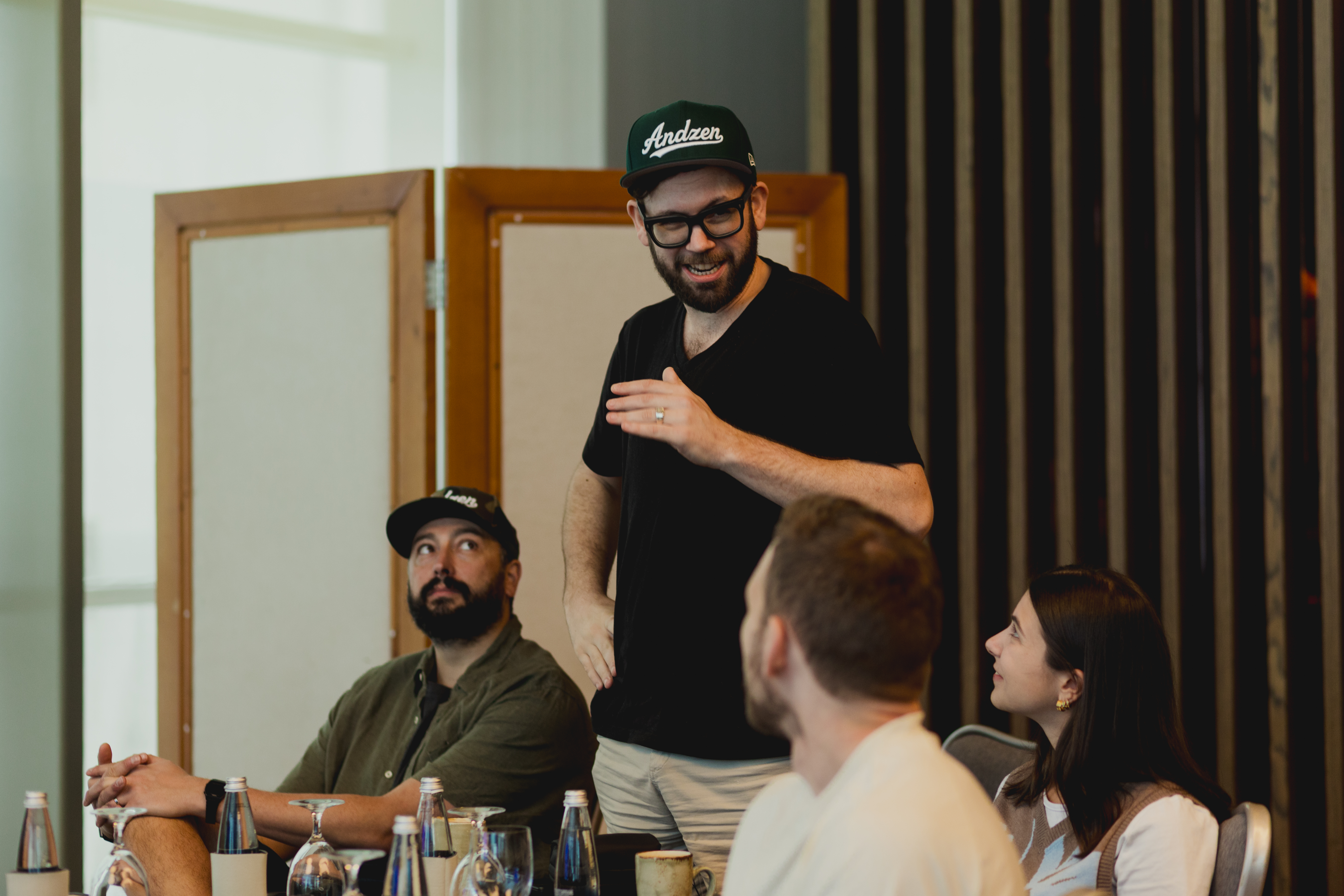
At our roundtable at the EASummit in Seville a fortnight ago, the founder of a two-person agency described a marketing set-up that will sound familiar to most people reading this. Referrals work. Turning up to events in person works. Cold outbound, even the carefully personalised kind, gets nothing back at all.
Then they asked a better question than most of us ever get round to. At what point does it become a problem that all of this runs through me?
The answer from the room was short
🌟 The day you want to sell 🌟
It's not a question many founders ask themselves. It usually gets asked for them, across a table, by someone holding a spreadsheet and a very polite expression. By then it's an expensive question.
Most of you are the marketing
In the same session we ran an anonymous survey of 28 agency founders and leaders, which became the Leaky Tap Report. 71% said most of their new clients came from referrals and partner introductions. When we asked who actually does the agency's marketing, the most common answer was the founder, when there's time. The most common amount of time was nought to two hours a week.
So for most agencies, the marketing engine is one person's reputation, one person's phone and one person's LinkedIn profile, running on whatever's left of a Friday afternoon.
That's fine while you're the one running the business. It stops being fine the moment somebody else has to.

How a buyer looks at you
A buyer isn't buying your last three years. They're buying your next three, and underneath every question in due diligence sits the same one: does this still work if the founder goes?
One UK M&A adviser put it neatly in The Drum this summer.1 Buyers don't acquire stories, they acquire cash flows they believe will continue. Agencies where the founder sits at the centre of client retention and commercial decisions suffer twice. First, the founder becomes a bottleneck on growth. Second, the buyer sees operational risk, and prices it.
How much do they price it at? One broker puts the discount at 15 to 30% when the founder is the main rainmaker or client contact.2 They also tell the story of an agency that lost a major client after the founder announced they were leaving, which knocked $900k off the sale price.
Another adviser's worked example makes the point more bluntly.3 A $2m agency with strong fundamentals might sell for 1.8 times revenue, so $3.6m. The same agency, with heavy owner dependency and a couple of oversized clients, might get 0.8 times. That's $1.6m.
Same revenue. Same team. Same office plants. One of them has a founder who closes every deal.
The pipeline is the bit they can't fix
Most of what a buyer worries about can be fixed with time and money. Delivery can be documented. Client relationships can be handed over to account managers across a year of slightly awkward lunches. Finance can be cleaned up by someone who enjoys that sort of thing.
New business is different. If your enquiries come from your face, your network and your dinners, the buyer is acquiring a company that's about to lose its sales department. They can't recruit your reputation in month one, so they do one of three things. They knock the multiple down, they push part of the price into an earn-out, or they walk.
Earn-outs turned up in about a fifth of private deals last year, and where they did, the median was worth 31% of what was paid at completion.4 An earn-out is a buyer politely saying "we'll believe it when we see it", then asking you to stay on for two years and prove it. If the whole reason you wanted to sell was to stop being the pipeline, that's a special kind of irony.
And if you never sell, the first half of that adviser's point still applies. A business that can only grow as fast as one person can network isn't going to grow very fast.

A quick test
Five questions. Be honest, nobody's watching.
What share of last year's new clients came to you personally, rather than to the agency?
Who owns your email list, and does anyone send to it when you're on holiday?
Could someone else run your next event, report or webinar from start to finish?
Do prospects know what the agency thinks, or just what you think?
If a buyer asked for pipeline by source for the last 12 months, could you send it today?
Then the big one. If you went somewhere with no signal for three months, would new enquiries keep turning up?
If you winced at more than two of those, you're in good company. You're also sitting on a discount.
What an engine you own looks like
None of this means the founder should go quiet. Your voice is often the best marketing the agency has. The aim is for it to become one channel among several, rather than the whole plan. In practice, that means building a few things that belong to the company.
A list, not a following. Your LinkedIn followers are attached to your profile, and when you go, they go with you. A newsletter list belongs to the business. It can be measured, it compounds, and it goes in the data room. The advice from the room in Seville was simple: send on a steady cadence, time it for when your reader actually reads, and never sell in it. The newsletter's job is to make people trust you before they need you.
Research with the agency's name on it. The Leaky Tap Report took a QR code, a room full of people and about three minutes of their time. Research works because it gives people a reason to talk to you that isn't a sales call. One comparison report we ran with partners brought in 300 marketing-qualified leads. To get a survey going in a new market, a tech partner paid for a €50 voucher for every completed response, which is a lot cheaper than flying a founder round Europe. And the Tech Leaders Survey we built with Rotate° brought in 100 leads from brands that weren't on Shopify, which for a Shopify agency is about as close as you'll get to a wish list.
Rotate° was recently acquired by Huge, The Tech Leaders Survey is now theirs to run. If you want a neat illustration of the difference between marketing that belongs to a founder and marketing that belongs to a business, it's hard to beat a piece of research that changed hands in the deal.
Surveys and benchmarks keep generating conversations for years, and they're the one kind of content a competitor can't copy, because they weren't in the room. Buyers have noticed. One firm of media dealmakers says research, insight and data-led businesses are getting particular attention from acquirers at the moment.5
Outbound that asks rather than sells. That founder in Seville was right that cold outbound mostly fails. It fails when it asks for a meeting. It does a lot better when it asks for something smaller and more flattering: take part in our survey, give us a quote for this piece, let us run a free technical audit on your site. One development agency in the room builds lists of sites on the platforms it supports and opens with exactly that audit. These are plays with steps, which means someone who isn't you can run them.

Events that don't end at the bar. Most agencies treat an event as the finish line. Instead, send a thank you, then the photos, then something worth reading on the topic you discussed, and only then move people onto the newsletter. That way the warmth from the room lasts long enough to turn into something.
You, as a channel. Keep posting, keep speaking, keep turning up. Just make sure it's scheduled into a plan the team owns, rather than being the plan.
Start before you need it
The same dealmakers say preparation for a sale starts years before the process, not months.5 A marketing engine is a good example of why. You can't build three years of list growth, published research and pipeline data in the six weeks before an adviser starts asking for it.
The odd thing about all this is that nobody pays a premium for being indispensable. They pay a premium for a business that would carry on quite happily without you. It's a strange thing to aim for when you've spent years being the reason it works.
Even if you never sell, an agency that doesn't need you to win its work is a much nicer one to own. You might even get your Friday afternoons back.
If you'd like help building a marketing engine that belongs to your agency rather than to you, that's what we do at Waye. You know where I am.