
.jpeg)



Six figures, four inches
The largest deals in B2B get decided on a phone. Almost nobody builds for that.

Somewhere this morning a director of ecommerce woke up at a brand turning over £40m a year. Before their feet hit the floor, before the kettle, before a coherent thought had formed, they picked up their phone. They cleared a few emails. They had a scroll on LinkedIn. Later, dropping the kids at school, they finished a podcast episode where someone in your category said a thing that lodged itself somewhere.
None of that felt like buying. That is the entire point.
The deal that eventually lands with six figures attached to it will get transacted somewhere sensible; a procurement portal, a DocuSign, a PDF opened at a desktop with legal cc’d. But the decision was made long before any of that, across dozens of small moments, most of them on a phone, and none of them showing up in your pipeline as anything you’d recognise.
We keep building campaigns for the moment of transaction. The demo. The forty-page proposal nobody reads past slide four. Meanwhile the buyer made their mind up weeks earlier, in bed, with one thumb.
The 6am shift
This isn’t a hunch. It’s just where people are.
Roughly 58% of people check email first thing in the morning, before anything else online.1 And somewhere between 55% and 60% of all email opens now happen on a phone.2 So when you picture your carefully-sequenced nurture email arriving, don’t picture a desk. Picture a duvet. Picture someone half-awake, deciding in about three seconds whether your subject line is worth a thumb-tap or a left-swipe into the bin.
The same person does it again last thing at night. The inbox check before sleep is the bookend to the inbox check on waking. Two of the most private moments in anyone’s day, and your brand is loitering in both of them.
None of this is new. That’s what makes it strange that so little gets designed around it.

Awareness became ambient
Brand recognition used to be a thing you bought in a burst. Now it’s a background hum, and most of it plays through a phone speaker or a pair of earbuds.
Podcasts are the clearest example. About 86% of listeners have a phone as their primary listening device, and two-thirds of them say they’ve looked into a product or actually bought something after hearing it on a show.3 That’s not an ad slot. That’s someone spending forty minutes with a voice in their head while they walk the dog, coming away warmer to a category than any banner has ever managed.
TikTok does a cruder, faster version of the same job. A founder you follow says something sharp about your exact problem, you don’t act on it, and three weeks later their company’s name surfaces in your memory when a colleague asks who does this sort of thing. You’ll swear blind you found them yourself.

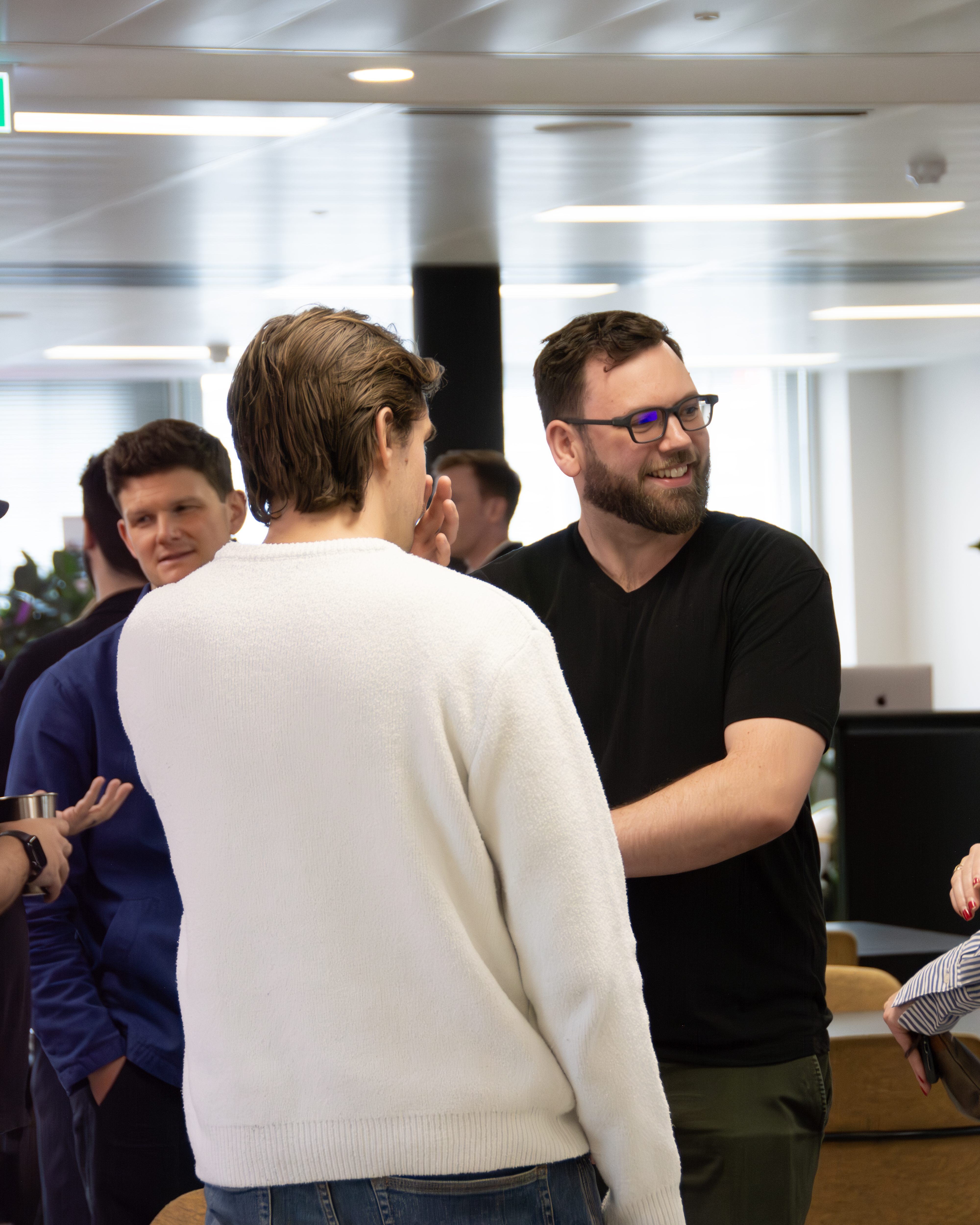
The industry does its mingling in rooms like this. Then everyone goes home and the actual persuasion carries on in the DMs.
LinkedIn does the heavy lifting, and gets none of the credit
This is the engine room. Most LinkedIn members do their browsing on mobile, one widely-cited figure puts it near 70%,4 while traffic-based measures have it far lower, around 27%.5 That gap mostly tells you the measurement is a mess, not the behaviour. Either way, the feed is a phone feed.
Here’s the annoying bit for anyone who lives by engagement metrics. Your most valuable readers never touch the like button. The buying committee reads everything you post and reacts to none of it. They’re building a private read on whether you actually know your stuff, and they’ll finish that picture months before they ever fill in a form.
You’ll know them by their opening line: “I’ve been following you for ages.” That sentence is a receipt. It’s proof of a long, invisible courtship that your dashboard logged as precisely nothing. The deal lands tagged “direct” or “referral,” and some last-click somewhere takes the credit for work that forty earlier posts actually did.
This is the dark funnel, and it’s where most of the persuasion in a six-figure deal actually lives. You can’t see it. Doesn’t mean it isn’t happening.
The intimacy ladder
Watch how a real deal moves and you’ll notice the channel gets more personal as the trust builds.
It starts with a post someone reads over breakfast. Then a comment. Then a DM; “loved this, do you ever work with brands like ours?” Then it graduates to email. Then, at some point, comes the sentence that means you’ve actually won: “just WhatsApp me.” And the final rung, the one that tells you a human being genuinely rates you, is the voice note. Ninety seconds of unedited thinking, recorded on a Saturday walk, sent to you because typing felt like too much friction for what they wanted to say.

Trust gets built off-stage, in aprons, over something that isn’t a pitch. By the time it’s a deal, the conversation has left the CRM entirely.
Every rung on that ladder is more mobile than the last. By the time real money is on the table, the conversation has usually left the CRM entirely and moved somewhere your marketing team can’t see and your legal team would rather not think about.
Now the part you can actually control
Here’s where most of this turns practical. The awareness stuff is diffuse and the DMs are personal, but the assets in the middle are entirely yours to get right or get badly wrong.
A gated 40-page PDF is a coffin. You send it, they mean to read it, they save it “for later” on a screen where “later” never arrives, and it gets forgotten in a downloads folder. An 11-field form is worse. Nobody is completing eleven fields with a thumb on a train that’s about to enter a tunnel. Around 70% of people delete an email outright if it doesn’t render properly on their phone,2 and the same instinct runs all the way downstream of it.
So the gated content that works is the kind built for the glass, not the printer. Interactive. Web-native. It’s what a benchmark report becomes when you let someone poke at their own numbers and see where they sit, instead of handing them a static file to pretend they’ll read. A landing page that loads before the tunnel. A form that asks for an email and then gets out of the way. The interactive version doesn’t just convert better, it survives the environment it’s actually being opened in.
If your best content can’t be consumed one-handed, it can’t be consumed at the moment your buyer is actually paying attention. And that moment, as we’ve established, is a duvet at 6am.
“But I can’t prove any of it”
This is the objection, and it’s a fair one, so let’s meet it head on.
You can’t prove it the way you prove a paid search click. The whole thing is dark by nature. But there are two things worth holding onto.
First, self-reported attribution beats your analytics stack for this. A single free-text box on a form, “how did you actually hear about us?”, will tell you more truth about a six-figure deal than any multi-touch model, because the buyer remembers the podcast and the posts even when your tracking remembers nothing.
Second, patience. A deal this size runs six to eighteen months. If you’re judging mobile nurture on last-click ROI inside a quarter, you’ve picked the wrong instrument. This is a compounding game. The posts you write today are seeding the “I’ve been following you for ages” you’ll hear next spring.
The decision and the receipt
So here’s the reframe worth leaving with.
There are two separate events in every big deal, and we routinely confuse them. There’s the decision, and there’s the transaction. The transaction is the visible one, the signature, the portal, the desk, the PDF with legal on cc. It’s the bit that shows up in the numbers, so it’s the bit that gets the budget and the attention.
But the transaction is only the receipt. The decision happened weeks or months earlier, in a hundred pocket-sized moments, on a four-inch screen, at the two most private hours of someone’s day. The desk does the paperwork. The phone did the deciding.
Build for the phone. That’s where the deal is.
Sources
58% of people check email first thing in the morning - Sales So, Mobile Email Statistics. salesso.com
55–60% of email opens occur on mobile, and ~70% of recipients delete an email that doesn’t render properly on a phone - 99Firms (Litmus, Stripo, Mailmodo). 99firms.com
~86% of listeners use a phone as their primary podcast device; two-thirds have researched or bought after hearing a podcast- Podcastatistics. podcastatistics.com
Nearly 70% of LinkedIn users access on a mobile device- Cognism, LinkedIn Statistics. cognism.com
Traffic-based measurement (Semrush) puts LinkedIn mobile access at ~27%- Meetanshi, LinkedIn Statistics. meetanshi.com