We asked 28 agency bosses how they market themselves. Most of them would sack a client for it.
What ecommerce agencies admit about their own marketing when you promise not to tell anyone
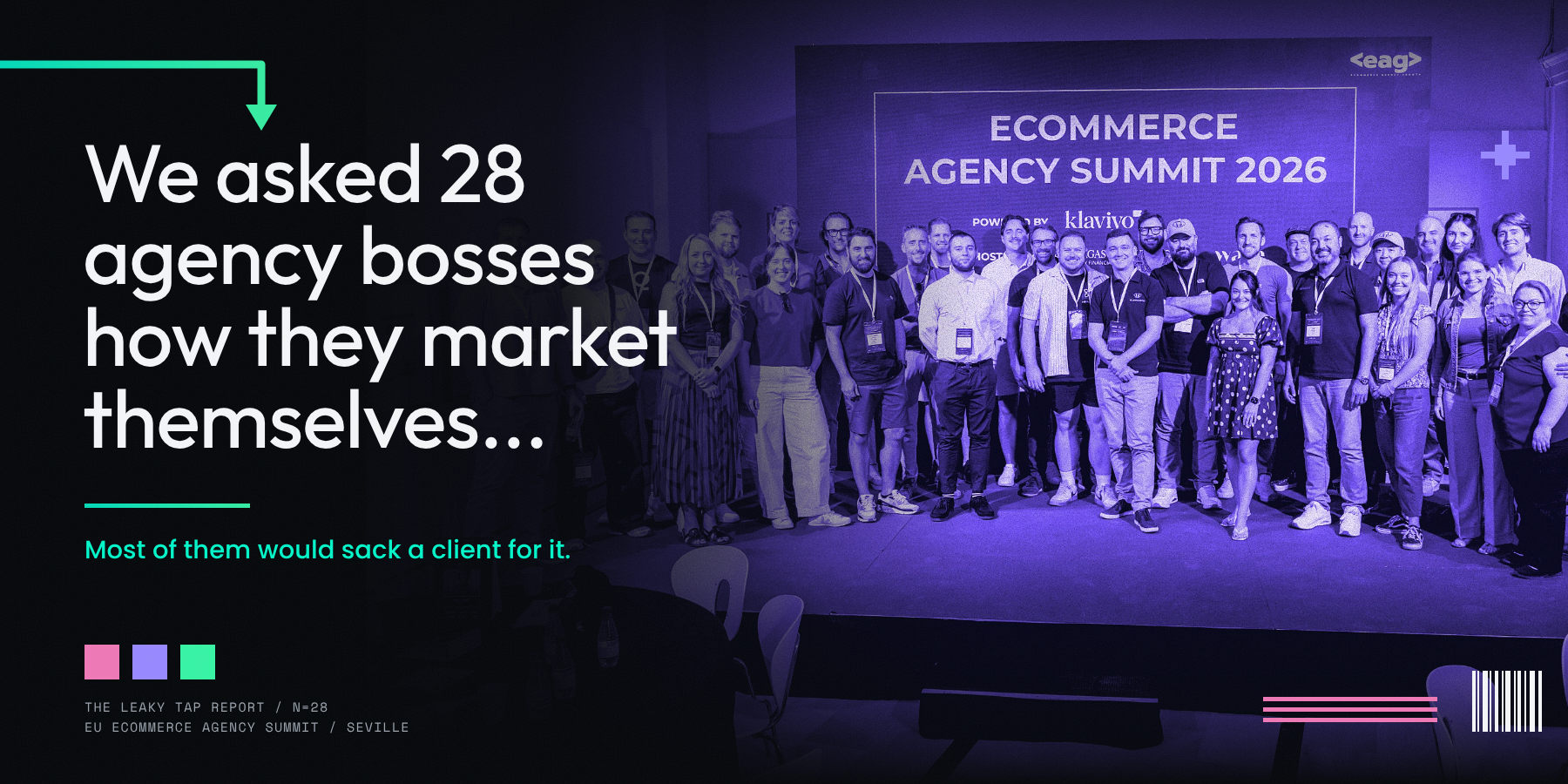
I've been to enough agency events to know what happens when you ask a room how its marketing is going. Everyone says "really well, actually", and then goes to the bar and admits they haven't posted anything since about 2019.
So in Seville we made it anonymous. Twenty-eight agency founders and leaders filled in a short survey on their phones during my talk, and within the hour we'd turned their answers into a report. Nobody's name is on any of it, which is the only reason the answers are worth reading.

Where the work comes from
71% said their main source of new clients was referrals or introductions from partners. Outbound got 14%, inbound 7% and events 7%. Paid ads got nothing at all, from a room largely made up of people who run paid ads for a living.
There's nothing wrong with referrals. In some ways they're the best marketing there is, because a recommendation costs the person making it something. They're lending you their reputation, and the buyer knows it. The trouble is you can't order more of them. You can't ring a happy client in January and ask if they'd mind being a bit more enthusiastic about you this quarter because you've just hired two developers. So you wait, and you hope, and you call it a pipeline.
Which might explain the next answer. Asked whether they know what they'll close in the next six months, 21% said yes, to within about 20%. 57% said "roughly". 21% said they had no idea.

I'm fond of "roughly". It's what people say when someone at home asks how much the new bike cost.
The smaller agencies were the most in the dark, with 36% of those under €500k admitting they had no idea. In the €3m to €10m bracket nobody did, although there were only five of them, so I wouldn't read a great deal into it.
Do as I say, not as I do
The question I was most looking forward to came in two halves. How many hours a week does your agency spend on its own marketing? And how many would you tell a client your size to spend?
The most common answer to the first was nought to two. The most common answer to the second was six to ten. Half the room would advise a client to put in more hours than they put in themselves, which is a bit like a personal trainer turning up to your session with a kebab.
As for who actually does it, 39% said the founder, when there's time, and there never is. 11% said whoever's free that week. One brave soul ticked "nobody, honestly", and if that was you, I'd like to buy you a drink, because you were the only person in the building who didn't round up. Just 39% have someone whose actual job it is.

The robots are writing it, and you can tell
57% said most or nearly all of their content over the last three months was drafted by AI. I'm not going to clutch my pearls about that. We use it too.
But I also asked whether a competitor could stick their logo on your last piece of content and publish it as it was. 54% said yes or probably. Among the agencies using AI for nearly everything, that rose to 71%.
That's the cost that never makes it into the business case. When something costs nothing to make, it tends to mean nothing to the person reading it. Nobody has ever been moved by a free biscuit.
On a related note, 39% have never published anything they thought might annoy someone. I understand the instinct. Nobody wants to be the agency that upset Shopify on a Tuesday. But a post that nobody could possibly disagree with is a post nobody will remember, and a surprising number of agencies are paying good money to be forgotten.
What clients actually bought
The free-text answers were the best part, mostly because people will type things into a box at two in the afternoon that they'd never say into a microphone.
We asked what was keeping them up at night. Seven said pipeline. Six said operations and growing pains. Six said AI and whether they'd still have a business in a few years' time, and some of those were properly bleak.
"In five years, will every company be able to do this for themselves as table stakes?"
"Not knowing who we'll be in 2 years."
Then we asked why the last client they won said they'd chosen them. Nine said expertise, usually off the back of an audit. Eight said the relationship. Two said ChatGPT had recommended them, which I genuinely didn't see coming and am still slightly put out about.
"We showed them very in depth analysis of their business."
"Personal touch."
"Vibe check af."
So agency owners are lying awake worrying that a machine is about to make them pointless, while their clients are picking them for a thorough audit, a decent conversation and, in at least one case, the vibes. A machine can't do any of those on your behalf, although it did find two of them some work, so perhaps don't block the crawlers just yet.
What I'd do about it
If most of your work comes from people who already trust you, the job of marketing is easy to describe and annoying to do. You need more people to trust you before they need you.
The audit seems to be what wins the work, so I'd stop hiding it in the sales deck and start publishing what you find, anonymised, as often as you can. I'd give marketing an owner, even if that owner only gets Friday mornings, and I'd guard those Friday mornings like a dog with a sock. I'd publish things a competitor couldn't put their name to, which usually means your own data, your clients' problems, or the thing everyone says in the pub and nobody posts. And I'd start forecasting, however badly, because a bad forecast written down every month slowly becomes a good one, and a feeling never does.
Why I bothered
Mostly to prove a point. Everyone can make content now, so content on its own is worth roughly what it costs, which is nothing. What still has value is the stuff you can't type into a prompt, like what 28 agency bosses will admit when you promise not to tell anyone. That took a QR code, a room and about three minutes of people's time.
You could do the same with your clients, your audit data or your next event. If you'd like a hand, you know where I am.
The full report has the rest of the confessions, the data to play with, and a small benchmark that tells you how leaky your own tap is.
